

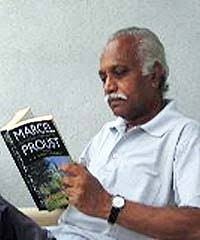

Benign Flame: Saga of Love
Blurb
The attractions Roopa experienced and the fantasies she entertained as a teen shaped a male imagery that ensconced her subconscious. Insensibly, confident carriage came to be associated with the image of maleness in her mind-set. Her acute consciousness of masculinity only increased her vulnerability to it, making her womanliness crave for the maleness for its gratification.
However, as her father was constrained to help her in becoming a doctor, she opts to marry, hoping that Sathyam might serve her cause though the persona she envisioned as masculine, she found lacking in him. But as he fails to go with her idea, she becomes apathetic towards him, and insensibly sinks into her friend Sandhya’s embrace, for lesbian solace.
Soon, in a dramatic sequence of events, Tara, a suave call girl, tries to rope Roopa into her calling; Roopa herself loses her heart to Sandhya's beau Raja Rao, and Prasad, her husband’s friend falls for her. And as Prasad begins to induce Sathyam to be seduced by whores to worm his way into her affections, Roopa finds herself in a dilemma. However, as fate puts Raja Rao into Roopa’s arms in such a way as to lend novelty to fiction, this ‘novel’ nuances man-woman chemistry on one hand, and portrays woman-woman empathy on the other.
Who said the novel is dead; 'Benign Flame' raises the bar as vouched by -
The plot is quite effective and it’s a refreshing surprise to discover that the story will not trace a fall into disaster for Roopa, given that many writers might have habitually followed that course with a wife who strays into extramarital affairs - Spencer Critchley, Literary Critic, U.S.A.
The author has convinced the readers that love is something far beyond the marriage tie and the fulfillment in love can be attained without marriage bondage. The author has achieved a minor revolution without any paraphernalia of revolution in the fourth part of the novel – The Quest, India.
The author makes free use of – not interior monologue as such, but – interior dialogue of the character with the self, almost resembling the dramatic monologue of Browning. Roopa, Sandhya, Raja Rao and Prasad to a considerable extent and Tara and Sathyam to a limited degree indulge in rationalization, trying to analyse their drives and impulses – The Journal of Indian Writing in English.
Overall, Benign Flame is a unique attempt at exploring adult relationships and sexuality in the contemporary middle-class. All the characters come alive with their cravings and failings, their love and their lust. Benign Flame blurs the lines and emphasizes that life is not all black and white - it encompasses the full spectrum of living - Indian Book Chronicle.
Book Excerpt - Chapter 1 Ramaiah’s Family
That winter night in the mid-seventies, the Janata Express was racing rhythmically on its tracks towards the coast of Andhra Pradesh. As its headlight pierced the darkness of the fertile plains, the driver honked the horn as though to awake the sleepy environs to the spectacle of the speeding train. On that, in the S-3, were the Ramaiahs with their nine year-old daughter Roopa.
Earlier, from Ramavaram, it was in the nick of time that Ramaiah took Janaki to Vellore for the doctors to extricate her from the jaws of death. Now, having been to Tirupati for thanksgiving, he was returning home with his wife and Roopa they took along for the sojourn. While her parents were fast asleep, Roopa sat still on a side berth, reminiscing her times at the hospital where Janaki took one month to recuperate under Dr. Yasoda’s care.
Soon the train stopped at a village station, as though to disrupt Roopa’s daydreams of modeling herself on the lady doctor at the Christian Medical College Hospital, and as she peeped out, the ill-lit platform seemed to suggest that the chances of her being Dr. Roopa could be but dim. Ramaiah too woke up to the commotion caused by the incoming passengers, and was surprised to see his daughter still awake, lost in her thoughts.
“What are you scheming my darling?” he said in jest.
“Naanna, won’t you make me a doctor?” she said as though in a trance.
“Haven’t the nurses already made you a junior doctor?” he said affectionately, bringing her escapades at the hospital back into her mental focus, and pleased with her idea, he patted her to sleep, even as he recalled his anxieties associated with her birth.
Ramaiah was jolted from his reverie as someone in the compartment switched on the light, to prepare himself to alight at the coming station.
‘Surely she would shape up into a dusky beauty. Won’t she be bright as well?’ he thought, looking at Roopa in her deep sleep, and recalled her escapade when she was hardly three.
“You know how clever our Roopa is?” said Janaki, at bedtime. “She wanted the timepiece to fiddle with and when I refused to give in, she cried no end. When she forgot what she was crying for, she cried to know why she cried at all! What a unique girl our Roopa is!”
As the train moved into a major junction, Ramaiah got down, looking for a coffee vendor. Unable to find even a tea vendor, he lit his Berkeley without a beverage. When the guard whistled the start, a half-naked urchin jostled past Ramaiah into the bogie to crouch in the vestibule. While the train was on the move, Ramaiah wondered whether the urchin had crouched to draw warmth from his heart to ward off the chillness, and pitying him, as he gave him some money the lad took as a matter of right.
‘Isn’t there something called gratitude?’ thought Ramaiah, feeling disregarded. ‘Is he so naive that he knows not civility? Or could he be an outcast, unfamiliar with the niceties of society?’ Ramaiah looked at him intently as though for a clue.
‘Is it possible that his exposure to the elements in his nakedness should’ve robbed his body of its sense of feeling?’ he thought, finding the wretched lad as cool as a cucumber. ‘Now, what he needs most is a piece of cloth to cover him with. After all, money wouldn’t provide warmth by itself, would it?’
Ramaiah went to his trunk to fetch a vest for the urchin. Seeing him wear it without even looking at him, Ramaiah wondered whether the lad was indifferent to the world in general.
‘Could life get worse than that?’ Ramaiah wondered, as he tried to go back to sleep on his allotted berth. How was he to know that one day, despairing for love, Roopa would personify the wretched side of life itself.
The outbreak of the day, which brought the sun on to the horizon, woke up Ramaiah. Realizing it would still take an hour to reach Ramavaram, he was inclined to inaction. The chillness of the wintry breeze and the warmth of the sunny dawn struck him for their contrast. Looking yonder, he saw the dew filled fields bejeweled by refraction and thought that they brought luster to the Master’s Creation.
When Janaki woke up, as Ramaiah folded up the berth, providing space for those in the aisle to rest their weary legs, there was enough room in the compartment for the assorted characters waiting in the vestibule.
Soon, the newspaper of the day was split into four that preoccupied as many. As its center page landed in the lap of the one opposite, Ramaiah couldn’t help but crane his neck to screen the bold print therein. However, all the pages came to him, though in a crumpled shape, enabling him to go through the copy before the vestiges of the paper were restored to whom it belonged, but not before the scandals in it were savored by those present.
Having finished with the newspaper in that intermittent reading, Ramaiah puffed away at his freshly lit Berkeley, and looking out from the window, he began to admire the scenery filled with greenery. When the landscape around looked familiar, he woke up Roopa and goaded Janaki to move towards the exit. Soon he too joined them with the bag and baggage.
Waiting near the wash-basin, Ramaiah remembered the lad and looked for him, and not finding him, he thought, ‘That is life. It has a destination even for the destitute.’
Soon Ramaiah leaned out of the slowing train to ascertain the platform.
-----
When the train screeched to the welcome chores of the waiting staff of the Ramavaram Station, alighting from it with the precaution associated with an occasional traveler, Ramaiah hurried his family towards the exit like a habitual commuter who catches the train on the move.
“The postmaster might’ve brought bagfuls of news,” the ticket collector at the gate greeted Ramaiah, alluding to the village postmasters’ penchant to peruse the post before delivery.
“The only news is that the Mails are running late,” was the Ramaiah repartee as he handed over the tickets.
Once out, he engaged two cycle rickshaws to take them home.
Ramavaram was a mini town as its residents loved to call it. With just five hundred houses, it was no more than a village in Ramaiah’s childhood but grew rapidly to house thirty thousand souls by the time Roopa was born. Well, the explosion in its population owed more to the migration than to procreation, and that represented the trend all over. While the natives lamented that the place was bursting at its seams, the settlers felt it was brimming with activity. However, all were proud to belong to it, not to speak of the Ramaiahs.
Life was running its routine course in Ramaiah’s household until fate ordained a tragedy, as though to ensure Roopa’s resolve to become a doctor was not dissolved in the myopic dreams of her imminent maidenhood, Rukmini, her elder sister, orphaned her son for want of postnatal care at the government maternity home that came up by then.
“Nature’s victim of procreation and man’s means of recreation, that’s what woman is,” bemoaned Janaki.
‘Only as a doctor can I help women,’ resolved Roopa to herself.
With Rukmini’s premature death causing consternation in the concerned households, the elders, in due course, went into a huddle, and decided it would be in the best interests of the motherless child if Suguna, the deceased’s sister, married the widower. So after a decent wait, while Suguna replicated her sibling in her brother-in-law’s life, Roopa too matured as though nature intended to synchronize her body with her mind.
While Roopa resembled a flower at dawn with its dew on, her complexion of tan was in consonance with the radiance of her velvet skin. Even as her vivacious features acquired softness as though to project the sweetness of her nature, her gaze gave way to glances as if to convey her innate inclinations. While her nascent bust was akin to a curious maiden peeping out from behind the curtain, the oni she wore strived to veil her maiden form. Her emerging figure and her diffident disposition lent tentativeness to her gait that seemed like the calibrated movements of a virtuoso danseuse on the way to the crescendo. Though in her interaction, she was modesty personified that strangely enhanced her sensual appeal, nevertheless, while watching the boys on the sly, she withdrew from them with inhibition. However, embellishing her unique persona, she came to have a mind of her own.
Once when she debunked the puranic tales of cock-pecked wives as perverse male stratagems to enslave women, Janaki was truly alarmed.
“These tales of female fidelity have a purpose of their own,” said Janaki to Roopa. “Since nature made men promiscuous, it’s the female loyalty that holds the marriage in the long run, for the benefit of the family and the society as well. These tales have a moral for men as well for they underscore the fact that it’s the wife who sticks through thick and thin with their man and not the lascivious lasses with whom they come to stray.”
As Roopa remained unconvinced and minced no words about the fallacy of the proposition, Janaki realized that old wives tales were no longer a currency with the educated girls. So she thought it fit to reason it out with her and Chandrika, her unmarried daughters, about the pitfalls of premarital sex and thus closeted with them one evening.
“I think it’s time I talk to you about the proclivities of youth,” Janaki began enigmatically. “To be drawn to boys at your age is but natural and desirable even. It helps the healthy development of your sexuality. Infatuation is the narcotic of the nascent youth, and if only the dosage is right, it could bring in small pleasures that delight. On the other hand, a thoughtless overdose could cripple your womanliness forever. While being friendly with the boys, beware of their attitudes and be aware about your vulnerabilities. They pursue for the final favor doggedly until they are dog-tired. Nature made them that way and for a purpose; female fulfillment is the purpose of male desire. It’s left for you to draw your own premarital lines. Do not get into those situations that might let you part with that for which they court you so fervently. If only you interact with easy virtue, your date could doubt your ability to resist a future seducer. Thus, if you favor your lover in a hurry, you might end up losing him besides that by which men measure women. And that would be enough to put you in a doghouse for life.”
Janaki extracted a promise from Chandrika and Roopa that they wouldn’t indulge in premarital sex.
-----
Ramaiah’s household was jolted from its routine that April at the news of his impending transfer to Kakinada, though on promotion. And as if to relieve them from the obligation to stay back, Janaki’s parents passed away in quick succession even before the transfer order was on hand. Whatever, Ramaiah welcomed the development as it would entail better schooling for the children, especially to Raju his only son, and expose them to a liberal environment as well.
Once the dynamics of change came into play in Ramaiah’s household, the inertia of lethargy gave way to the novelty of life. The house with a backyard that they rented in Ramaraopeta made everyone feel at home. While Janaki enjoyed the company of better-educated women from the neighborhood, the children were excited at the prospect of their schooling in the English medium. Exercising his increased power over an enlarged body of subordinates, Ramaiah too felt at home at the Head Post Office.
When he got Chandrika admitted in the PR College in the intermediate, he felt as though he was paying due respects to his Alma Mater. While Roopa enrolled in the Govt. Girls High School for her pre final, Raju joined the McLauren High School in the eighth class.
While Ramavaram became a distant memory for all of them, Roopa came to realize that she became the object of boys’ attention and the subject of girls’ envy. Nevertheless, she didn’t see any contradiction in that, for she had come to appreciate the value of her sexuality. Her teachers’ compliments about her cerebral caliber only furthered her sense of confidence.
Mid way into the first-term, when Roopa was on top of the world, Sandhya, the daughter of the new Joint Collector, joined the class. About the same age as she was, Sandhya was shorter by a fraction but rosy in complexion. While she looked cute and lively, in her slim frame, she carried herself with that grace often associated with the children of the well-off from the cities. The sophistication of her manner, and the chastity of her accent, acquired at the Hyderabad Public School, put everyone in awe, the teachers included, but her modesty and friendliness enabled her classmates to flock to her in their numbers.
However, Roopa felt like the spirited person at a dinner party, who would have lost the audience upon the arrival of a celebrity, and acted in a like manner; she didn’t join the bandwagon but when Sandhya herself sought her help to catch up with the syllabus, Roopa obliged her, having felt vindicated. While Sandhya was impressed with the keenness of Roopa’s intellect, the warmth of Sandhya’s persona attracted Roopa. The closer they became, the more they admired each other. Moreover, the more they came to know about one another, the fonder they became of each other. Soon, they were seen only together.
As the final exams neared, they co-studied at Sandhya’s place during the preparatory holidays. With Kamalakar and Damayanthi, Sandhya’s parents, having readily taken to Roopa, she felt at home at the Joint Collector’s Bungalow, where she found a large collection of fiction, which she began to pore over. Ramaiah, recalling his teacher’s advice to him that classics would improve one’s language, deepen his vision and broaden his horizons, was glad that his daughter was on the right track though he himself had missed the bus.
Soon enough, Ramaiah was forced to take stock of his situation. Agricultural income became meager ever since they left Ramavaram. After all, the lessee of their depleted landholding made it a habit to blame it upon the drought to deny Ramaiah his due. Besides, as all the eligible accounts were discounted, there was no way to have a loan from his office. As for their ancestral dwellings, the modern houses that came up made them antiques already. Thus, Ramaiah began to feel as if he reached the dead end of Ramavaram.
“Why not dispose of all that?” he broached the topic with Janaki. “What with the diminishing returns, they’re assets only for the record. But if only the old man were alive it would have been a different story.”
“With the ‘land for the tiller’ thick in the air, better we come out clean,” she gave the green signal. “You better sell away whatever little my father left me as well.”
When he returned from Ramavaram, after having sold what all they had, he felt as though his umbilical cord with the place was severed. With those proceeds, he proceeded to acquire an old building in Gandhinagar as their ‘old age shelter’ as he put it. The rest of the fund he deposited in a scheduled bank to take care of future needs.
Chapter 2 Realities of Life
After that summer recess, with the reopening of the PR College, Roopa, and Sandhya joined in the Intermediate, and as though to signal the end of their schooling, they shed their skirts to switch over to saris. Looking all the sweeter in their sweet sixteen’s as they entered the campus that day, Roopa in her snuff chiffon sari and Sandhya in her Gadwal cotton one, they created quite a sensation.
The delectable contours of Roopa’s well-proportioned body of five feet five appeared accentuated by her narrow waist as her curvy figure in that velvet skin lent form to her sari meant for enhancing her modesty. Her robust breasts that dared the veiling, and the thick seat, which hugged it tight, made it seem that her genes strove hard to enhance her sex appeal. While her tapered arms that abutted on her flowing frame lent poise to her persona, swung by the swing of her seat in her tantalizing gait, her hair in plait pictured a pendulum that caressed her bottom. As the radiance of her face gave an aura to her charming manner, her self-belief was in consonance with her sensuality. Moreover, the imbibed sophistication in Sandhya’s company gave style to her substance that made her ravishing.
Sandhya’s rosy complexion, in congruence with her angelic soul, imparted pleasantness to her persona. While her slim figure and sharp features defined aesthetics, her sparkling eyes reflected the spirit of her lively nature. Even as the evocative features of her supple frame brought fluidity to her movements, the radiance of her silken skin ennobled her womanly assets. As her smooth brown bobbing hair added style to her demeanor, her sweet manner lent poise to her figure. Enhancing her appeal her gait was such that the fall of her sari acquired the rhythmic grace of the loom on which it was weaved. With her gaiety being in harmony with her youth, the alacrity of her mind conjugated with her sprightly nature making her gorgeous.
Whereas the effervescence of Sandhya’s ethereal beauty was apparent at espial, the magnetism of Roopa’s charm compelled for its conjuration in interaction. The friends became a great hit with the boys who tried to befriend them. However, whenever accosted by a lad, Roopa tended to turn into a bundle of nerves.
“You make such a heavy weather of the whole thing, the poor things might end up being dumb,” Sandhya was wont to tease Roopa.
‘When I could get on well with boys at school, why am I ill at ease with them, now? But the way they look at me make me feel different and diffident, won’t they?’ wondered Roopa.
However, the searching look she espied in the male eyes thrilled her in her vitals. As she tried to visualize herself through their perception, her body, in her own eyes, acquired a new dimension. The more she became mentally closer to the opposite sex; all the more she distanced herself from the boys. Sandhya, on the other hand, proved to be a cool customer known to unnerve the dashers. While her glamour gave her a rare aura that overawed the boys, her father’s position only confounded their confidence. Nevertheless, Chandrika, who by then was in B. Com., pre final, helped them in their initiation into the campus life.
------
When Chandrika got her degree and Roopa was through her Intermediate with flying colors, what with the recalcitrant Raju too seemed to mend his wayward ways, for the Ramaiahs it seemed time flew as if it developed wings. However, proving that good things won’t last forever came the jolt as Roopa revealed the cards that she so closely held to her chest all along.
“Do you know what it takes to be doctor?” said a surprised Ramaiah.
“Know I’ve topped the class,” she said naively.
“But sadly, we’re short of means,” he said helplessly.
“Naanna, I’m craving to be a doctor,” she said.
“Sorry dear, it’s impossible,” he dismissed her in despair and left in dilemma for the Post Office
‘How I took it for granted!’ Roopa wondered all day; maybe when one is obsessed with a singular aspect of a situation, the attendant issues fail to get the focus they deserve.’
When a distraught Roopa approached her mother pleading for her support, affected by her daughter’s passion, Janaki promised to persuade Ramaiah. While Roopa hoped for a miracle as the condemned would to escape the noose, however, on Ramaiah’s return, she avoided him like the one who tends to hide himself from the one commended for the favor. When Ramaiah sent for her, after what appeared to be an eternity for her, she went up to him with her heart in her mouth.
“Now I recall that night on the train when you were just nine,” he said, patting her head as she squatted beside his easy chair. “Though I was pleased with your ambition then, I never imagined you could be nursing it so vigorously. If not, I would’ve cautioned you in time.”
“Naanna, it became my obsession, I’ll be miserable otherwise,” she sank into his lap.
“You know we’re lower middle-class now,” he seemed to give an account of his helplessness. “The lands are all gone and I’m going to retire soon. Agreed there is some money in the bank but it would barely meet your dowries and your brother’s higher studies. This house, of course, is for your brother lest he should curse me for having left him nothing to inherit. As for your mother and I, the pension should see us through.”
“Why not pledge the house, I’ll redeem it later,” she suggested with apparent hope.
“Be realistic dear, once you’re married, your earnings would be your husband’s. More so to marry you off as Doctor Roopa, I’ve to cough up much more for your dowry,” reasoned Ramaiah.
“Then, I won’t marry at all,” she said with such a conviction that startled Ramaiah.
“Don’t be silly, the essence of life lies in its wholesomeness. You would realize later on, that nothing is worth in life to the exclusion of all the rest that makes it what it is. Above all, marriage is the key that opens life alike for the boys and the girls,” he said, showing her the reality of life.
“It’s my sole ambition naanna,” she persisted, hoping against hope.
“Ambition is a double-edged sword; possessed by the resourceful, it’s cut out for success and in the hands of the lesser souls, it hurts their peace of mind,” he turned to philosophy to help her depressed soul.
Then he recounted his own disappointment; his inability to become an advocate, and advocated to his daughter to learn to take life as it came, ordained by karma. “If I were an advocate, perhaps, I would have been rich enough to fulfill your ambition. However, it was not to be, and therein lies our fate - yours and mine as well,” he concluded.
Roopa, though reconciled to her situation, resented her fate. As if she were revenging on her helplessness, she shunned the sciences and opted for commerce. However, as per her inclination, Sandhya went in for the humanities.
“Are you tired of dissecting frogs and all?” said Sandhya in jest as Roopa filled in the admission form.
“Like to have a closer look at the material side of life,” said Roopa mystically.
“Jokes apart, tell me what’s wrong. I know you wanted to study medicine,” said Sandhya as they got into a rickshaw.
Roopa could only manage a deep sigh for an answer.
“They say a friend is one with whom you can think aloud and you know that’s what I do with you, but then it’s up to you,” said Sandhya empathically.
“Know I love you the most and yet somehow I wasn’t frank with you; but from now on, I’ll think aloud with you,” said Roopa earnestly, and blurted out.
Moved, Sandhya enlaced Roopa, which brought solace to the latter and induced warmth in the former, making both of them feel loved and wanted by the other.
Chandrika, who graduated that year, didn’t think in terms of post graduation as la affair Roopa gave the clue to her father’s mind and the family’s finances, and so, thought of a job for an occupation.
“Sit still till we fix a match as it might improve your complexion a bit, besides, I don’t want any complications, that’s all,” Janaki was dismissive.
When Chandrika persisted, Ramaiah, however, relented, and persuaded his wife,
“You’ve to change with the changing times. Moreover, some boys have started preferring employed girls for their brides.”
After a couple of unsuccessful attempts, Chandrika got an assistant’s job in an export firm for a salary of two-fifty. Her first take-home pay, however, enabled her mother to appreciate the virtue of having another earning member in the family.
-------
Hardly a year passed before the ‘changing times’ stared the Ramaiahs in their faces in their complexity as ‘the other earning member’ of the family turned out to be an errant soul of the household.
Chandrika declared that she would like to marry her colleague, though of a lower caste, and Janaki threatened to jump into the well to spare herself, the shame of her daughter’s alliance. Ramaiah though tried to reason it out with Chandrika by saying that if she married out of caste, none would marry Roopa. Besides, it won’t be in her own interest either, to live with someone from a lower caste as adjusting to married life in an alien milieu will be all the more difficult. When the time comes for finding matches for her children, shunned by both the communities, she would realize that she had a cross to bear. Better she gave up the idea, for her own good.
Given her own disappointment, Roopa was empathic to her sister’s feelings and felt that she could understand the true import of Chandrika’s predicament.
“What to do now?” said Roopa to Chandrika having led her out into the backyard.
“I wish I weren’t in love,” said Chandrika stoically.
“That’s neither here nor there for you’ve to act one way or the other,” Roopa was solicitous.
“I may perish like the Buridan’s ass, unable to decide whether to first drink water or eat oats,” Chandrika was melancholic.
“Then why not try and forget him?” said Roopa.
“Time would do that for both of us but life without him is not what I want,” said Chandrika.
Roopa kept quiet as though inviting her sister to give vent to her feelings.
“I’m being pulled apart by the family sentiment on one side and the lure of love on the other; love seems to be the most compelling of human emotions as it combines in it the craving of the soul and the desires of the body,” said Chandrika melancholically.
“Oh, how you’re hurt!” said Roopa sympathetically.
“I don’t mind hurting myself but I’m worried about him and concerned about our mother. Moreover, how can I compromise your marriage prospects? That’s my dilemma,” said Chandrika dejectedly.
That her sister should think about her welfare, even in her predicament, melted Roopa’s heart.
‘If only I could help her love, what if, I marry out of turn to clear the hurdle?’ thought Roopa.
She felt she knew her parents well enough. They were conventional more for the society’s sake than out of personal conviction. Besides, they loved their children dearly. She was confident that all would welcome her idea. The prospect of her averting an imminent schism in the family appeared heroic to her.
‘How nice it can be,’ she thought excitedly, ‘if my sacrifice serves my sister’s cause besides solving my parents’ problem.’
Though she was pleased to perceive herself in the role of a martyr for the family cause, however, on second thoughts, she contemplated the implications of her marriage without a degree as she was just through the first year of what appeared to be a three-year ordeal.
‘How I nursed the dream of being a doctor,’ she thought melancholically. ‘Haven’t I come to love myself in that role? Now that the bubble has burst, I couldn’t care less. Hasn’t life become humdrum, anyway?’
As she recalled her own disappointment, she remembered her father’s words - your earnings would be your husband’s – and saw a ray of hope in the situation.
‘What if my husband helps my ambition to further the family income?’ she thought hopefully. ‘Who knows I may as well get an understanding husband. What a happy life I would lead then! Won’t I love him even more for that? Let me take a chance and see what lies in store for me. Anyway, I’ve nothing to lose, do I?’
It seems the feature of life that while darkness deprives man of his shadow; his hope lingers on in spite of the foreboding.
As Chandrika wept inconsolably, it seemed Roopa’s fear of the unknown was washed away in her sister’s tears. Thus having made up her mind, Roopa unveiled the contours of her plan of action, however, hiding the hope behind her apparent sacrifice and that about had the same effect on Chandrika, as sighting a boat in the high seas would have on a shipwreck; it raised her spirits. While Chandrika was profuse in articulating her gratitude, and as if to convey her indebtedness bodily as well, she hugged her sister, Roopa felt embarrassed as her own streak of selfish motive jarred with the purity of her sister’s outpouring.
It seems the attributes our hypocrisy induces others to adduce to us would bring no value addition to our own conscience.
However, as the sisters were confabulating without, Ramaiah had a tough time with his bitter half within.
“What went wrong with her brought-up? Nothing like this ever happened to anyone, even remotely related to us!” Janaki said puzzled.
“You know, women of the upper castes were insulated from men of the lower classes earlier,” he tried to explain the situation to her. “Social intercourse between caste groups was limited to the persons of the same sex. But all that has changed now. The society is truly open to both sexes from all sections. The pull of man woman attraction being what it is love has long since crossed the caste barrier causing marital trespasses. However, don’t get worried. For all that, her passion could be a passing phase, that can’t get past the first hurdle.”
Janaki prayed fervently for her daughter’s deliverance from that wretched affair. Just the same, when Roopa showed the silver lining, Ramaiah remained unenthusiastic.
“Inter-caste marriages would only lead to divorce as the couples tend to wind up the show at the first hitch; even otherwise, the inferior union would be ruinous in the end as they would be ostracized by the society for sure,” he articulated.
‘Though upper caste men would have no qualms having a fling with low caste women, they seek to shield their women from the men of that very stock,’ thought Chandrika, but said,
“I’m prepared for any eventuality.”
“After all, it’s her life; why not let her decide for herself?” said Raju, who was particularly fond of Chandrika and Roopa.
“Don’t oversimplify matters. What are the parents for if not to prevent their children’s follies?” retorted Ramaiah.
“You say everything in life is ordained by karma, so why not take this as her destiny?” interjected Roopa.
Ramaiah didn’t respond but remained unrelenting.
The sisters pressed the issue, and went on a hunger strike. The mother’s heart melted soon enough, and the father’s resolve dissolved, in due course. It was thus, Ramaiah wanted to have ‘a look at the fellow’ and see for himself, ‘What he’s worth?’
Soon the word went around that Ramaiah was on the lookout for a suitable boy for Roopa.
Read on in the free ebook https://g.co/kgs/865QNHX that's also in this Sample PDF